Oct 20, 2026
The two styles of Italian pasta, explained by the people who make it fresh every day Walk down the pasta aisle and you will find shelves of dried pasta, with a smaller chiller cabinet of fresh pasta nearby. It is easy to assume the chilled one is the better choice, yet most Italian kitchens keep both and Italians reach for each one for specific dishes. This guide covers how each is made, how they taste and cook, which sauces go with each one, and which comes out ahead on health. Once you know how they differ, choosing between them for any sauce becomes second nature.
What is dried pasta?
Dried pasta (pasta secca in Italian) is made from durum wheat semolina and water and nothing else. Durum is a hard, high-protein wheat that gives the pasta its firm bite. In Italy, dried pasta has to be made from durum wheat by law. The dough is pushed through metal moulds called dies to make each shape, then dried slowly until it is hard enough to keep in the cupboard for a year or more.
The best dried pasta is pushed through bronze dies, which leave a rough and almost chalky surface for sauce to cling to. Many mass-produced brands use smooth Teflon dies instead, which give a shinier pasta that sauce slides off more easily. You can usually tell by looking, because bronze-cut pasta has a matt, slightly dusty finish. The town of Gragnano near Naples has made dried pasta for centuries, helped by a mix of sea breezes and mountain air that was ideal for drying it outdoors, and Pasta di Gragnano has had protected status in the EU since 2013.
What is fresh pasta?
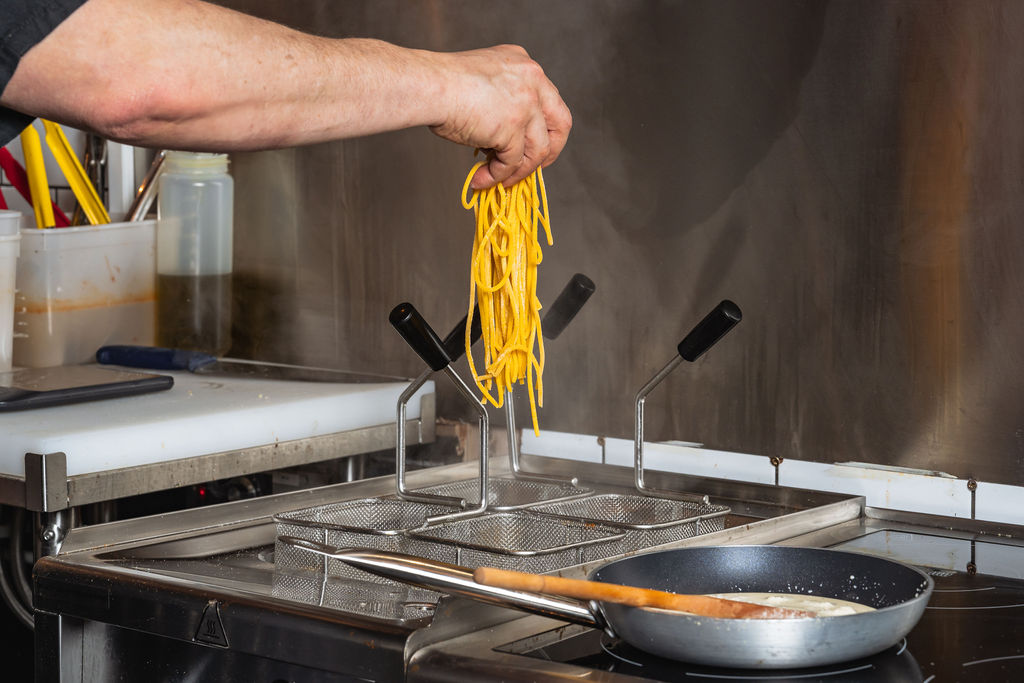
Fresh pasta (pasta fresca) is made to be cooked within a day or two. In northern Italy it is made from eggs and '00' flour, a very finely milled soft wheat flour. The result is silky and tender with a golden colour, and Emilia-Romagna is its heartland. Tagliatelle, pappardelle, tortellini and lasagne sheets all come from this tradition. In Bologna the dough is still rolled by hand with a long wooden rolling pin by a sfoglina, a skilled pasta maker, until the sheet is thin enough to see light through.
Down in the south, fresh pasta is often made with semolina and water and no egg at all. Puglia's orecchiette (little ear-shaped pasta) is a famous example, shaped one piece at a time with a knife and thumb, and in the old town of Bari you can still see it being made by hand outside people's front doors. In Sicily, busiate are twisted around a thin rod to make long spirals. Fresh dough is also how you get filled pasta such as ravioli, because it is soft enough to fold and seal around a filling.
How do fresh and dried pasta taste?
Fresh egg pasta is soft and tender with a rich flavour, and it soaks up sauce. Dried pasta has more bite and a cleaner wheat flavour. Cooked al dente (to the tooth) it should still have a little resistance in the middle. Fresh pasta softens quickly once it is drained, so it needs to go straight into the sauce and onto the plate, while dried pasta holds its shape for longer. Both are delicious and Italians choose between them depending on the sauce going with them.
How long does each one take to cook?
Fresh pasta cooks in two to four minutes and thin ribbons can be ready in under two. Dried pasta takes around eight to twelve minutes depending on the shape, and the time on the packet is a useful guide. Use plenty of well-salted water for both and taste a piece before you drain it. Save a mug of the cooking water too because the starch in it helps bring the sauce together.
Which sauces go with fresh pasta?
Fresh egg pasta loves butter, cream and rich meat sauces. In Bologna, tagliatelle with a slow-cooked ragu is the classic pairing, and the porous ribbons hold the meat in every forkful. In Tuscany, wide pappardelle are traditionally served with a ragu of wild boar or hare. Filled pastas like ravioli tend to get a light coating of butter and sage so the filling stays the star of the plate. Gentle sauces let the soft texture of fresh pasta come through.
Which sauces go with dried pasta?
Dried pasta is built for olive oil, tomato and seafood sauces. Its firm bite holds up to spaghetti alle vongole, a fiery arrabbiata or a garlic and chilli oil. Tubes and shells like penne and rigatoni trap chunky sauces inside. Roman classics such as cacio e pepe, carbonara and amatriciana are traditionally made with dried spaghetti, rigatoni or bucatini. Dried pasta grew up in the south, where cooking leans on olive oil and tomatoes more than butter and cream, so the shapes and the sauces developed side by side.
Is fresh pasta better than dried?
Neither one wins outright, because they come from two separate traditions. Fresh pasta is the treat for a relaxing weekend dinner or a plate of filled pasta, and dried pasta is the everyday staple behind many of Italy's best-known dishes. A bag of bronze-cut dried pasta from a careful maker will taste better than a poorly made fresh one, so quality counts for more than type.
Is fresh pasta healthier than dried?
The difference between them is small. Fresh pasta holds more water, so a plate of it often has slightly fewer calories than the same weight of dried pasta once boiled. Egg pasta adds a bit more protein and fat from the eggs, along with some cholesterol. Dried pasta served al dente is digested more slowly, and wholewheat versions add extra fibre. The sauce and the size of your portion make a far bigger difference to how healthy the plate is than the type of pasta underneath.
Can you make fresh pasta at home?
You can and you need very little equipment. A common starting point is 100g of '00' flour and one egg per person. Mix and knead it until smooth, then rest it for half an hour before rolling it out with a rolling pin or a pasta machine. The more often you make it, the better you learn how the dough should feel in your hands.
Fresh pasta at 27 Old Compton Street
At 27 Old Compton Street in Soho, all our pasta is handmade and made fresh every day, including shapes like bucatini, maccheroni and conchiglie. We are a tavola calda, a hot table where fresh pasta is cooked to order and brought to you fast. Try the bucatini cacio e pepe, the pumpkin ravioli with sage butter and amaretto, or the black squid ink lobster ravioli. If you want to have a go at home, Nima's Italian recipe book includes a fresh pasta how-to to get you started.