May 19, 2026
There are eleven bottles on the wine list at 27 Old Compton Street. We could have stocked twice as many, but a short list, well selected, does more for a guest than an overcrowded one. If you've been hunting for Italian wine in London with a real regional range, this is one of the smallest, most carefully curated lists in Soho. The cellar sits below the open kitchen, where fresh pasta is made to order at the tavola calda. The wine list runs through five Italian regions: Piedmont in the cool north, Veneto in the foothills around Verona, Abruzzo on the Adriatic coast, Puglia in the southern heel, and Sicily, where the sun and the volcano shape everything that grows. Below, we've taken it region by region, north to south.
Piedmont
Piedmont sits in the foothills of the Alps in Italy's northwest. It's a region of fog, truffles and slow autumn cooking, and home to some of the country's most prestigious bottles - Barolo and Barbaresco among them. We've gone for a quieter Piedmont classic, the one we pour by the glass.
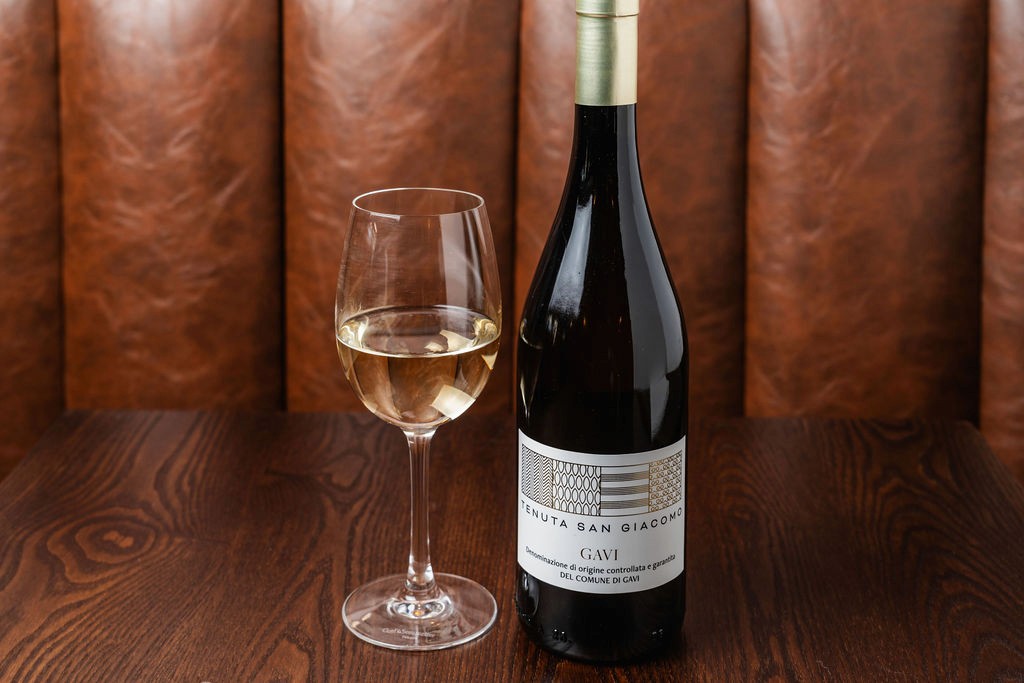
Gavi di Gavi, Tenuta San Giacomo (DOCG)
Gavi is made from the Cortese grape, grown in the rolling limestone hills southeast of Turin. The DOCG label on the bottle - Denominazione di Origine Controllata e Garantita - is Italy's highest wine classification, awarded only to regions that meet the strictest production standards.
In the glass, this is the most elegant white we pour. Crisp, dry, with green apple, lime peel and a saline minerality that comes straight up from the soil. Order it with seafood pasta, anything finished with butter and citrus, or as a first glass before the pasta lands.
Veneto
Veneto stretches across Italy's northeast, anchored by Verona in the west and Venice on the coast. It's one of the country's most prolific wine regions, producing crisp lake-side whites, soft rosés, and the great Amarones of Valpolicella. Four of our bottles come from here - more than any other region.
Sauvignon Blanc, 4 Generazioni, Casa Defrá (V)
Most drinkers know Sauvignon Blanc by its loud, grassy New Zealand expression. Italian Sauvignon Blanc is a quieter creature - more food-friendly, more restrained, built around white peach, pear and a clean mineral finish rather than tropical fruit. Casa Defrá's Veneto bottling sits firmly in that quieter style.
A natural pour with green pesto, lemon-based pasta, or anything light and herby.
Pinot Grigio, Uvam, Delle Venezie (V)
The Pinot Grigio everyone thinks they know - light, dry, easy to drink. This one comes from the Delle Venezie DOC (Denominazione di Origine Controllata, the second tier of Italian wine classification), the appellation that covers most of the region's Pinot Grigio production. Expect lemon zest, green apple and a faint almond finish.
Order it with lighter pasta dishes: linguine with clams, butter and lemon spaghetti, or anything where the wine should support rather than steal the show.
Pinot Nero, Mabis, Biscardo Rosapasso (Rosé, V)
Pinot Nero is the Italian name for Pinot Noir, the great grape of Burgundy. Made into rosé, it gives a pale salmon wine with strawberry, red cherry and a flicker of white pepper on the finish. It's dry rather than sweet, and the only pink on our list.
This is also our most flexible bottle - it crosses easily between whites and reds and works with almost everything on the menu. The one to reach for when the table can't agree on red or white.
Valpolicella, Ripasso, Casa Defrá (V)
Ripasso is a piece of Venetian winemaking craft. After the grapes for Amarone (Veneto's most prestigious red) are pressed, the leftover skins are still rich with concentrated sugar and flavour. Winemakers pour young Valpolicella back over those skins for a second fermentation, picking up extra body, depth and a hint of raisin-like sweetness in the process. The technique has earned the style a nickname: "baby Amarone".
In the glass, expect cherry, dried fig, cocoa and a warm, dried-fruit finish. The beef ragu would be an excellent match.
Abruzzo
Abruzzo sits in central Italy on the Adriatic coast, with the Apennine mountains rising to the west and the sea to the east. The region doesn't carry the same fine-wine prestige as its northern neighbours, but it produces some of the most honest, sun-warmed reds in the country - reds that pair instinctively with red sauces and slow-cooked meats.
Montepulciano, Terre Passeri
A quick note on the name. Montepulciano is a grape variety, not to be confused with the Tuscan town of Montepulciano, which is famous for a wine made entirely from Sangiovese. They share a name and that's about it. The grape we're talking about here is one of Italy's most-planted reds, and Abruzzo is its heartland.
Terre Passeri's Montepulciano is dark in the glass, with soft tannins, blackberry, plum and dried herbs. It's a generous, low-stakes red and a safe pour with almost anything tomato-based. We drink a lot of it ourselves.
Puglia
Puglia is the heel of Italy's boot. Hot, flat, and famous for olive oil, burrata and deeply ripe red grapes that thrive on the heat. The whites here are gentler than their northern cousins, built to be poured cold rather than studied. We've stocked three Puglian bottles.
Trebbiano, Cielo e Terra, Terre Allegre (V)
Trebbiano is one of Italy's most widely-planted white grapes. It turns up everywhere - in house wines, in Italian vermouth, even as the base spirit for Cognac in France. As a varietal wine it's rarely the show-stopper, but in the right hands it makes for clean, very drinkable whites.
The Puglian version pours light and bright, with green apple, lemon and a soft floral lift. It's easy-going, reliably crowd-pleasing, and a strong bottle to share at the start of a meal.
Sangiovese, Cielo e Terra, Terre Allegre (V)
Sangiovese is best known as the backbone of Chianti, but it's planted across Italy and changes character with the climate. In Puglia's warmer south, the grape becomes softer and riper - red cherry, plum, a touch of dried herbs, medium tannin, easy on the palate. It's the strongest all-rounder on our red list, and a wine that suits almost anything we pull out of the kitchen.
Primitivo, Sàn Patrime
There's a footnote on this one. Primitivo, Puglia's flagship red, shares its DNA with American Zinfandel - both confirmed in the 1990s as the same variety, traced back to a Croatian grape called Tribidrag. Italy is where it found its commercial home, and Puglia is where it thrives. The grape ripens to extreme sweetness in the Puglian heat, and the resulting wines are full-bodied and powerful.
Sàn Patrime's bottle shows ripe blackberry, fig, vanilla and warm spice, with alcohol running a little higher than most Italian wines. Order it with our meaty pasta dishes - sausage ragu, slow-cooked beef, anything with truffle.
Sicily
Sicily isn't really part of mainland Italy in any climatic sense. The island sits closer to Tunis than to Milan, baked by sun, fanned by sea air, and underlain in places by Mount Etna, the still-active volcano whose ash and minerals work their way into the vineyard soil. Sicilian winemaking has its own rhythm, its own native grapes, and some of the most characterful bottles on our list.
Grillo, Griari, Alagna
Grillo was historically grown for one purpose: to make Marsala, the fortified Sicilian wine. As Marsala fell out of fashion in the late twentieth century, Sicilian winemakers began bottling Grillo as a still white in its own right - and discovered a grape with real range.
This bottle is fresher and rounder than most northern Italian whites, with peach, lemon and a coastal salinity that comes from vineyards close to the sea. It pairs beautifully with fresh tomato-based pasta and any of our seafood dishes.
Nero d'Avola, Palazzo del Mare (V)
Nero d'Avola is Sicily's flagship red and the most-planted variety on the island. The grape ripens deep and dark under the Sicilian sun, producing wines with black cherry, plum, dark chocolate and a warm peppery finish. Medium-full body, structured tannins, a long warming finish.
It's a flexible partner for our reds, working as well with a ragu as with a classic vodka pasta.
How to choose
Eleven bottles, eight of them vegan, every one chosen to drink with the pasta we make. And if you can't pick from the list, ask. Our team will happily talk you through it and pour something to suit whatever's on your plate.
Walk in for a stool at the counter or reserve a table, and we'll see you soon.
Book a table | Explore the drinks menu
See the full wine list, have a look at our cocktails, or read more on our blog.